

About the Journal
Current Issue
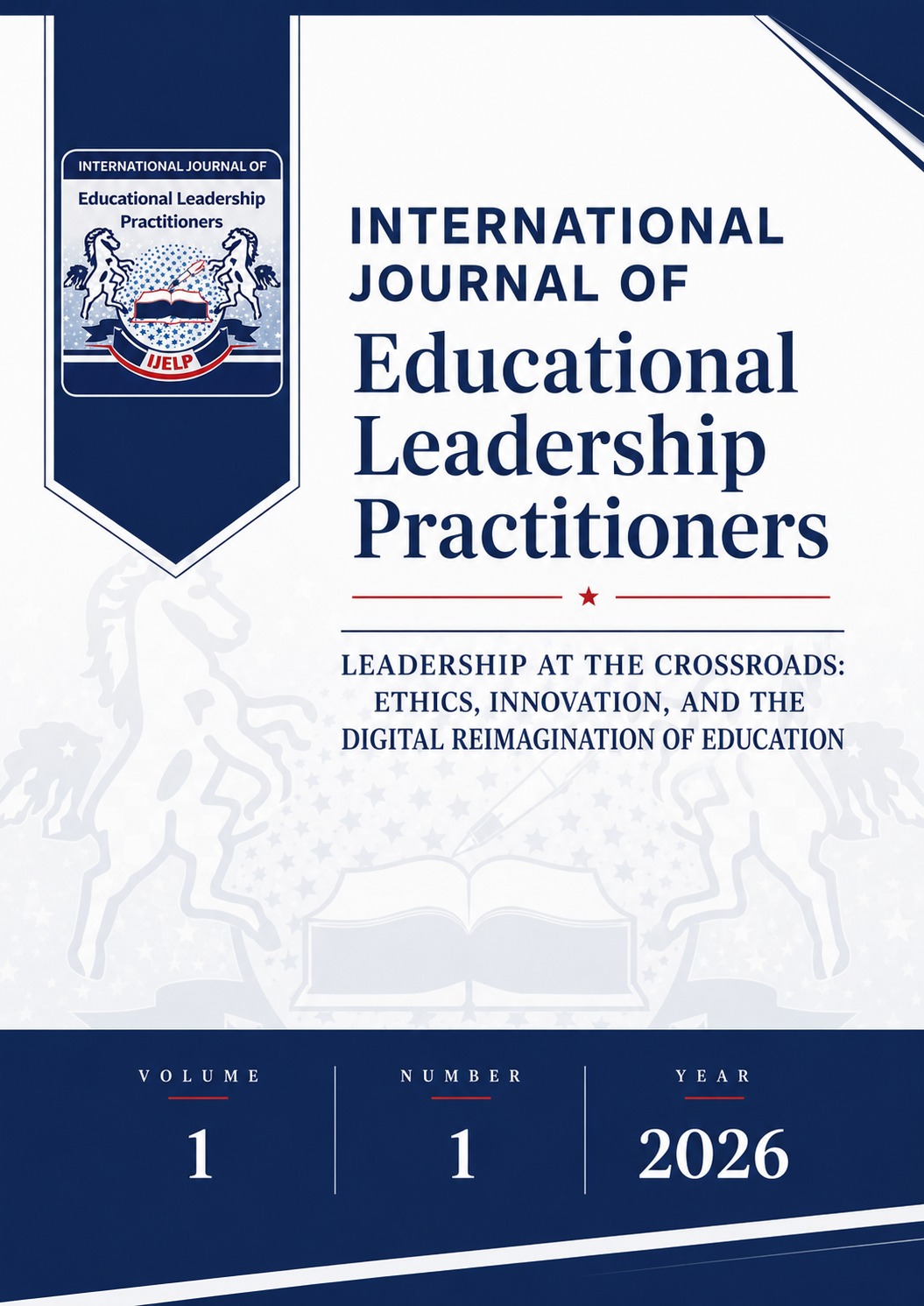
Across the globe—and acutely within developing contexts—educational institutions are being pressed by converging forces: artificial intelligence, digital transformation, cultural pluralism, governance scrutiny, and the rising expectations of a generation born into technological acceleration. Education leadership can no longer afford incremental adjustment. It must undergo principled reinvention.
This issue of the International Journal of Educational Leadership Practitioners (IJELP) is anchored in that reinvention.
The contributions in this volume collectively advance a powerful proposition: the future of educational leadership will be defined by its ability to integrate technological fluency, pedagogical innovation, cultural intelligence, and ethical integrity into a coherent model of institutional stewardship.
Published: 2026-07-02
Editorial
-
Professor Ajuruchukwu Obi (Author)
Articles
About the Journal
International Journal of Educational Leadership Practitioners (IJELP)
Aim and Scope
The International Journal of Educational Leadership Practitioners (IJELP) is dedicated to advancing scholarship and practice in educational leadership by fostering global collaboration and knowledge exchange among practitioners, researchers, policymakers, and stakeholders.
The journal provides a platform for the dissemination of high-quality research, innovative practices, and critical insights that contribute to improving educational leadership, institutional effectiveness, and educational outcomes across diverse contexts worldwide.
Objectives
IJELP pursues the following objectives:
- Facilitate Global Knowledge Exchange
Promote the sharing of ideas, experiences, and best practices across countries, cultures, and educational systems. - Publish Diverse Perspectives
Showcase a broad range of empirical studies, theoretical contributions, case analyses, and critical reflections that reflect the diversity of educational leadership contexts. - Promote Innovation and Excellence
Highlight innovative approaches, emerging trends, and best practices that drive transformation in educational leadership. - Inform Policy and Practice
Provide evidence-based insights to support policy formulation and effective leadership practices at institutional, national, and international levels. - Foster Collaboration and Networking
Encourage interdisciplinary dialogue and partnerships among scholars, practitioners, and policymakers.
Roles and Importance of the Journal
IJELP serves several critical roles within the field:
- Global Knowledge Hub
A platform for accessing cutting-edge research and diverse perspectives in educational leadership. - Cross-Cultural Engagement
Promotes understanding of leadership practices across different socio-cultural and institutional contexts. - Policy Influence
Contributes to shaping educational policies through rigorous, evidence-based scholarship. - Professional Development
Supports continuous learning and capacity building among educational leaders. - Advancement of Scholarship
Strengthens the theoretical and practical foundations of educational leadership research globally.
Editorial Board: Rules and Regulations
1. Composition and Membership
The Editorial Board comprises distinguished scholars, experienced practitioners, and experts in educational leadership from diverse geographical regions.
Membership is by invitation from the Editor-in-Chief, based on demonstrated expertise and scholarly contributions.
2. Roles and Responsibilities
Editorial Board members are expected to uphold the highest standards of integrity, professionalism, and academic rigour.
Key responsibilities include:
- Conducting timely, objective, and confidential peer reviews
- Providing constructive feedback to authors
- Supporting editorial decisions on manuscript outcomes
- Promoting the journal within professional and academic networks
3. Conflict of Interest
Editorial Board members must disclose any actual or potential conflicts of interest arising from personal, professional, or financial relationships.
Where conflicts exist, members may be recused from the review process.
4. Confidentiality and Peer Review
All submitted manuscripts must be treated as confidential documents.
- Manuscripts must not be shared or discussed with unauthorised parties
- Peer review comments are confidential and must not be used for personal advantage
5. Editorial Independence
Editorial decisions must be made independently and based solely on:
- Scholarly merit
- Relevance to the journal’s scope
- Contribution to the field
Decisions must be free from bias relating to authorship, institutional affiliation, or other non-academic factors.
6. Term Limits and Review
Editorial Board members serve renewable terms of [insert duration, e.g., two (2) years], subject to periodic performance review by the Editor-in-Chief and Governing Council.
7. Code of Conduct
Editorial Board members must adhere to the highest ethical standards in research and publication.
Misconduct—including plagiarism, falsification, or unethical behaviour—may result in removal from the Editorial Board.
8. Amendments and Updates
These policies are subject to periodic review and may be revised by the Editor-in-Chief and Governing Council as necessary.
All members will be notified of updates and are expected to comply with revised guidelines.
Closing Statement
Adherence to these guidelines is essential for maintaining the integrity, quality, and global credibility of IJELP as a leading journal in educational leadership.